Legibility Without Access
Legibility Without Access is an installation that stages a chain of translations across
time, media, and modes of perception. The work draws from Jules Verne’s
Voyages Extraordinaires, a literary project that sought to render the unknown
legible through science, narrative, and speculation. In this installation, those same
texts are reread by an artificial intelligence and reduced to affective responses
rather than summaries or interpretations.
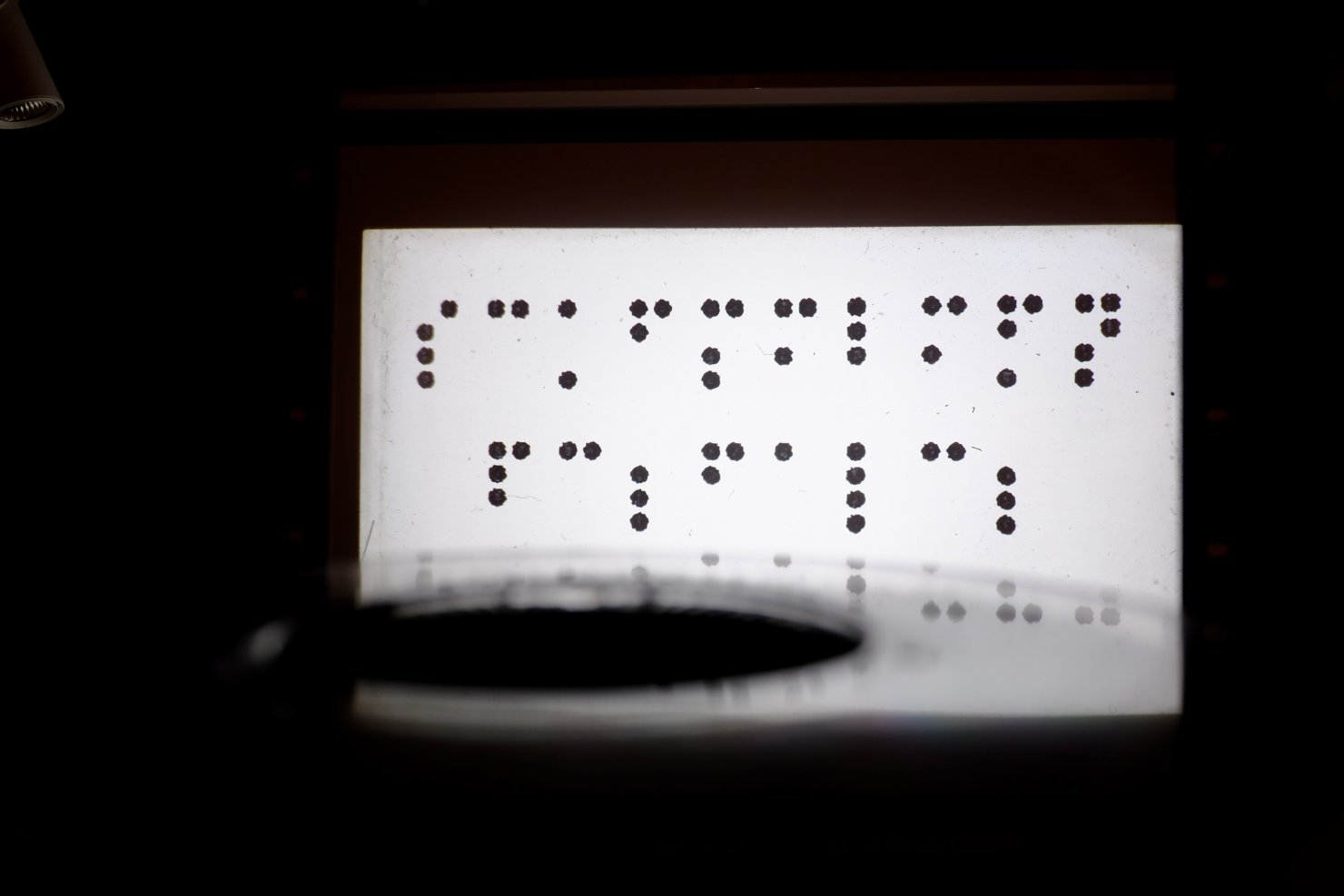
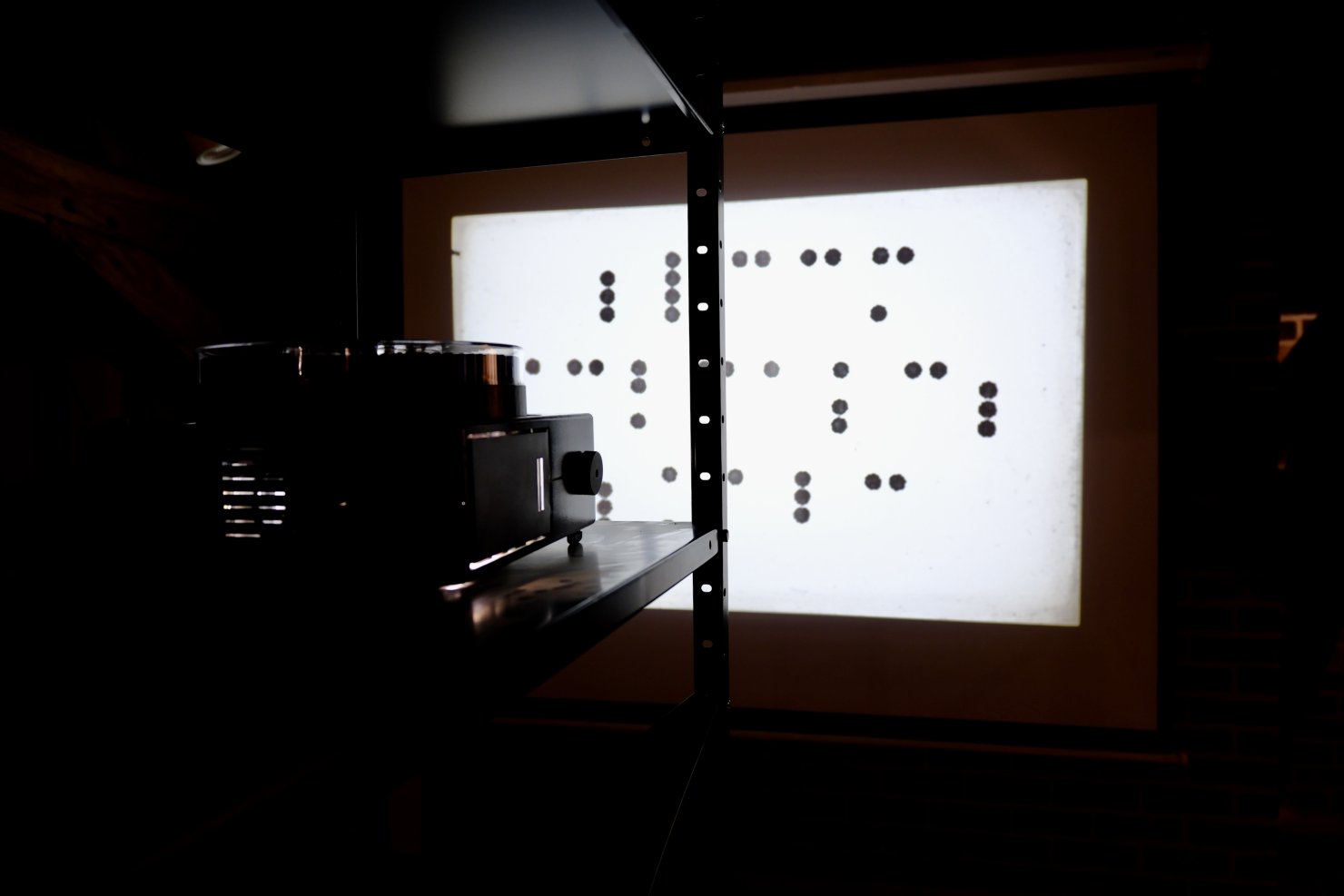
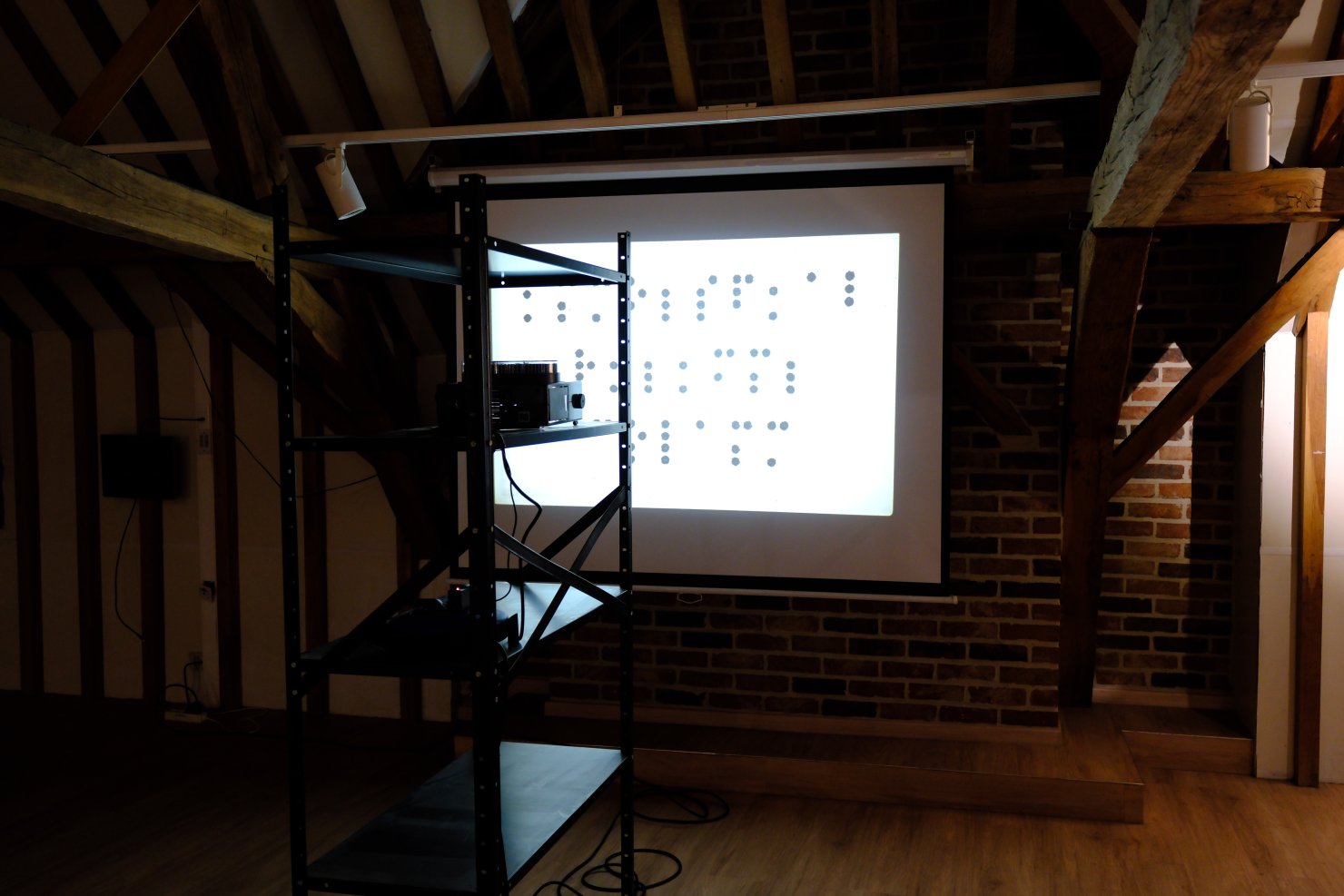
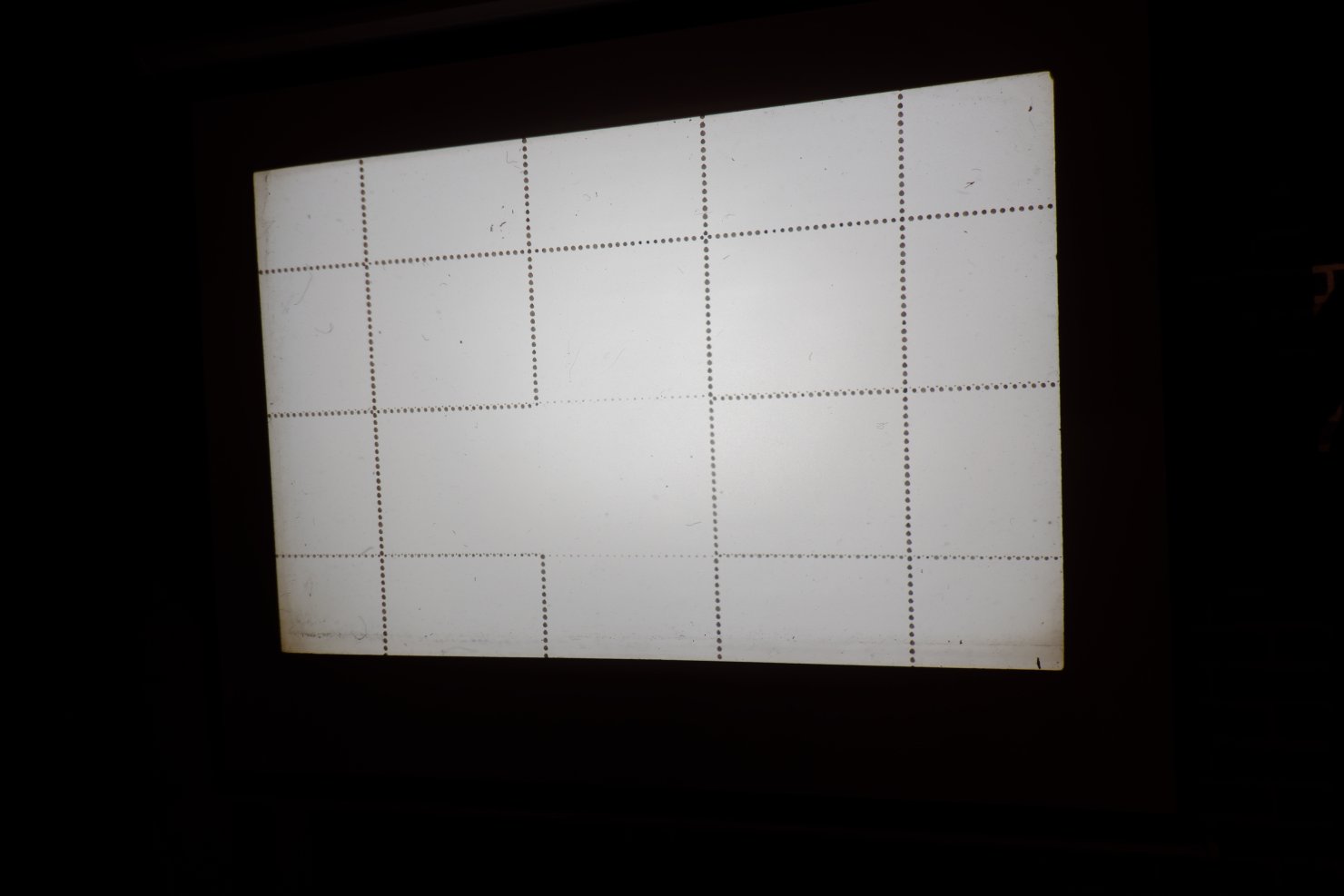
Legibility Without Access is an installation that stages a chain of translations across
time, media, and modes of perception. The work draws from Jules Verne’s
Voyages Extraordinaires, a literary project that sought to render the unknown
legible through science, narrative, and speculation. In this installation, those same
texts are reread by an artificial intelligence and reduced to affective responses
rather than summaries or interpretations.
Each projected slide corresponds to a single novel. Instead of images or
quotations, the slides display two-word sentiments generated by an AI reader,
encoded in Braille. Braille, a tactile writing system designed to be read through
touch, is here rendered purely visual. Its dots are enlarged, projected, and
suspended on the projection surface, transforming a language of accessibility into
an image of inaccessibility.
The use of an analog slide projector introduces another layer of mediation. Once a
dominant technology for the transmission of knowledge and memory, the slide
projector now operates as a relic. It projects information without interactivity,
insisting on duration, sequence, and mechanical rhythm. By pairing this obsolete
device with artificial intelligence, a technology defined by speed, scale, and
abstraction, the installation collapses multiple technological temporalities into a
single viewing experience.
Rather than clarifying Verne’s texts, the work withholds them. Narrative, character,
and scientific explanation are replaced by sentiment : admiration, unease, curiosity,
anxiety. These emotions are not claimed as universal truths about the novels, but
as the subjective output of a non-human reader trained on vast linguistic corpora.
Authorship is thus displaced, and interpretation becomes something delegated,
inferred, or trusted rather than verified.
Legibility Without Access foregrounds the tension between visibility and
comprehension, between presence and usability. Language is made visible but
unreadable ; meaning is offered but cannot be directly consumed. In doing so, the
work questions where interpretation resides in an era of machine reading,
mediated knowledge, and inherited futures. What remains is not information, but
affect, projected, encoded, and held at a distance.
PRINCIPLE AND OPERATION :
The installation operates on a one-to-one correspondence : one novel, one
sentiment, one slide. Each sentiment is generated by an artificial intelligence
reading Jules Verne’s Voyages Extraordinaires and distilled into a short affective
phrase. These phrases are not summaries or analyses, but emotional residues
produced through machine interpretation.
The sentiments are translated into Grade 1 Braille and rendered as dot matrices
optimized for projection. While Braille is designed for tactile reading, the work
presents it visually, deliberately removing its primary mode of access. The
projected dots function simultaneously as language and image.
Slides are printed at the physical dimensions of standard 35 mm transparencies
and projected using an analog slide projector. The mechanical sequencing of the
projector establishes a fixed rhythm and duration, independent of viewer
interaction. The installation thus combines automated interpretation, manual
production, and obsolete display technology.
Meaning emerges through accumulation rather than legibility. The work does not
invite decoding, but sustained attention to repetition, variation, and delay.
Interpretation remains indirect, mediated, and incomplete, by design.